
World Briefing 2026-10-07: Hormuz Flows Recover, Tankers Don't
Brent settled at $100.58 as Gulf crude flows recovered but tankers stayed scarce. Dry-bulk freight eased and the dollar softened after weak US jobs data.
Contents
- Key takeaways
- Gulf loadings recover, Brent back at $100.58
- Oil is moving; ships are not
- Dry bulk at a six-week low
- Dollar index at 101.833 after a 29,000 payroll print
- What shippers should check
- FAQ
- Where did oil prices close on 6 October?
- If more crude is flowing, why is shipping a problem?
- Why did the dollar weaken?
Key takeaways
- On 6 October December Brent settled at $100.58 a barrel and November WTI at $89.44, recovering from intraday lows.
- More Gulf crude is moving, but tanker charter rates were described as close to parabolic, making shipping the new bottleneck; the Baltic Dry Index fell to 3,002, its lowest since 25 August.
- September US payrolls rose only 29,000, and the dollar index eased 0.33% to 101.833.
More crude is leaving the Gulf, and a planned release from emergency stocks took some heat out of the market. Tankers did not keep up. Brent closed back above $100 a barrel, dry-bulk freight slipped to a six-week low, and the dollar eased after a soft US jobs report. For traders, fuel, hire, and the invoice currency did not move together.
Gulf loadings recover, Brent back at $100.58
On 6 October, December Brent settled 0.23% higher at $100.58 a barrel. November WTI finished a cent higher at $89.44. Intraday, Brent had fallen as low as $97.06, down 3.50%, and WTI to $86.86, down 2.88%, before both reversed. A day earlier Brent had closed at $100.32, down 1.89%, and WTI at $89.43, down 1.84%.
The bounce sat between easier supply and a tighter ship market. The largest independent oil trader said roughly 12 million barrels a day of crude and 2 million of products had left the Middle East over the previous seven to ten days. Without that flow, the firm said, a $200 Brent scenario is back on the table. A major producer said throughput on its pipeline to the Red Sea had reached 5.8 million barrels a day by Tuesday morning. Another cut the official price of its flagship light grade to Asian buyers to a six-year low. Brent is still about 65% higher this year.
The G7 agreed last Friday to release 100 million barrels of diesel and crude from emergency reserves and not to restrict energy exports. It did not say which countries or which grades. The US Energy Information Administration projected world petroleum output falling from 106.3 million barrels a day in 2025 to 101.1 million in 2026, and demand from 104.4 million to 102.4 million.
Sources: Financial News, 7 Oct 2026, Reuters, 6 Oct 2026, The Edge Singapore / Bloomberg, 6 Oct 2026
Oil is moving; ships are not
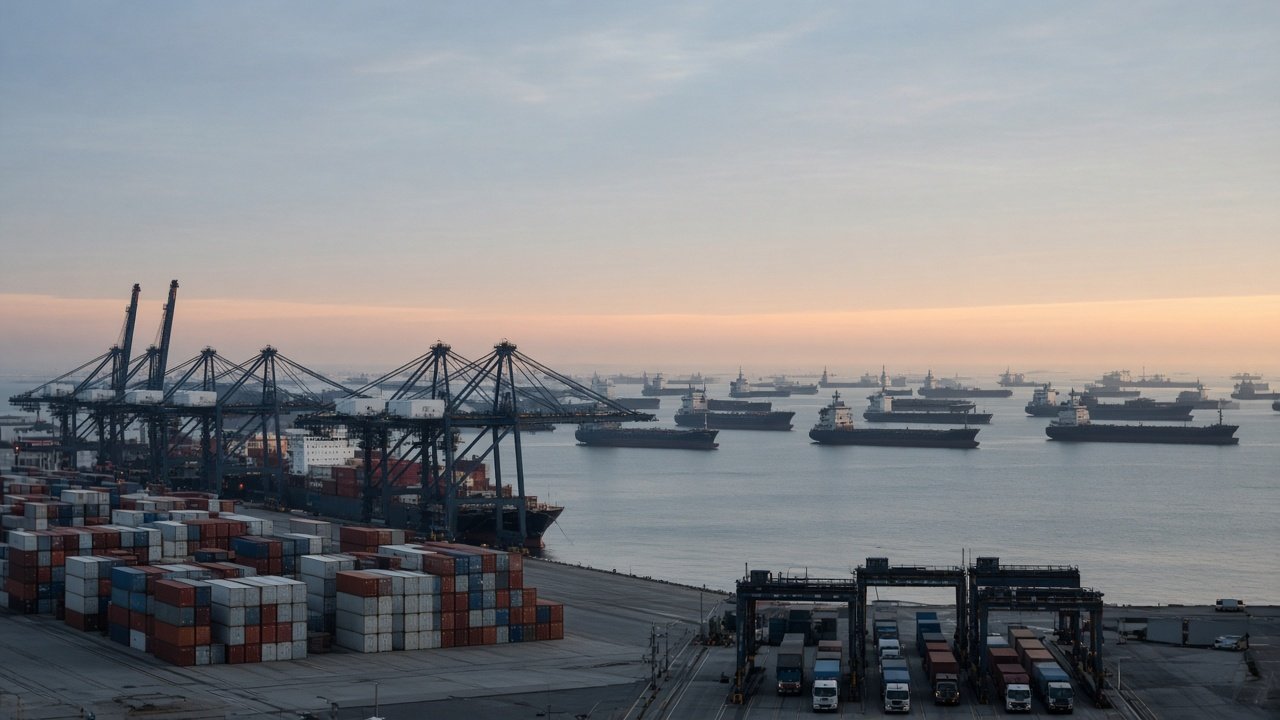
At the same London forum, the trading house described the squeeze as having shifted from crude, to products, to shipping. Charter rates were called close to parabolic, and refiners were said to be feeling it. Western inventories are largely drawn, so 10 to 14 million barrels a day through the maritime route is what keeps the winter balance. Product tightness is expected to run into the heating season, after damage to Russian refining and about five months of lost Middle East runs.
The routing is awkward. Tankers shuttle the strait and transfer cargo to ships waiting outside, which ties up tonnage twice. Kuwait is pumping about 75% of its pre-war level. Iraq is looking for extra vessels to move cargoes through the strait. A 1–2% move in the flat price can sit next to a much larger move in hire and war-risk premium.
Sources: Reuters, 6 Oct 2026, Financial Times, 6 Oct 2026
Dry bulk at a six-week low
Dry bulk did not follow the tanker market. On 6 October the Baltic Dry Index fell 68 points, or 2.22%, to 3,002, its lowest since 25 August. The Capesize index, tied to iron ore and coal, dropped 4% to 4,638. Panamax was nearly flat at 2,366. Supramax rose slightly to 1,795. Over the past month the BDI is down about 16%, but it is still about 54% above a year earlier. Larger ships weakened alongside softer iron ore and higher port arrivals during China’s National Day holiday. Smaller ships held up, which points to grain and minor bulk rather than ore and coal.
Sources: Trading Economics, 6 Oct 2026, FX678, 7 Oct 2026

Dollar index at 101.833 after a 29,000 payroll print
At 3 p.m. in New York the dollar index was down 0.33% at 101.833. The euro rose to $1.1261 and sterling to $1.3277. The dollar bought 158.12 yen, slightly firmer on the day. September nonfarm payrolls rose by 29,000, against a forecast of 90,000. July and August were revised down by a combined 60,000. Unemployment was 4.2%. Average hourly earnings rose 3.0% on the year, below a 3.2% forecast. Traders marked the chance of a Federal Reserve hike on 28 October at about 22%, down from about 50% a week earlier. Long-dated Treasury yields eased after touching 24-year highs.
Sources: Xinhua, 7 Oct 2026, Reuters, 6 Oct 2026
What shippers should check
For the background to the 1 October spike, see Brent jumps 4% on US carrier reports. If you are weighing container options while rates move, FCL vs LCL covers the basics.
Freight is split by cargo. Importers of Gulf crude, products, naphtha, or jet should price tanker hire and war-risk before the flat price. If charter rates are being described as near-parabolic, October bunker clauses and demurrage caps need a fresh pass. Dry bulk is the other way around: a BDI at 3,002 and weaker Capesize earnings give some room on iron ore and coal fixtures, but the index is still about 54% above last year.
On payments, 101.833 on the dollar index and 158.12 on dollar-yen are the marks. Dollar invoices may translate a little cheaper into euros and other majors than last week. Yen weakness still sits in Japanese parts and materials. With hike odds near 22%, forward cover ahead of this week’s US inflation data is the practical check.
On clearance, bunker and fuel surcharges lag the spot quote. The G7 release has no grade split, so diesel and marine fuel can stay jumpier than crude. Confirm that letter-of-credit shipment dates cover a strait shuttle and an offshore transfer, and that war-risk extends to the Gulf of Oman handoff. Use $100.58 Brent, $89.44 WTI, BDI 3,002, and a dollar index of 101.833 as today’s quote anchors.
FAQ
Where did oil prices close on 6 October?
December Brent settled 0.23% higher at $100.58 a barrel and November WTI at $89.44, after Brent had dipped to $97.06 intraday.
If more crude is flowing, why is shipping a problem?
The squeeze has shifted from crude to products to shipping, and charter rates have surged. Importers should price tanker hire, war-risk premium and waiting time before the flat oil price.
Why did the dollar weaken?
September nonfarm payrolls rose by 29,000 against a 90,000 forecast, and the dollar index fell 0.33% to 101.833.
Related posts

World Briefing 2026-10-10: Hormuz Tensions Keep Brent Near $104 and Freight Costs High
A strike on an LPG carrier in Hormuz kept Brent near $104 on 9 October. China's fuel-export restart and a WTO trade forecast raised to 3.9% now shape costs.
World Briefing 2026-10-08: Hormuz Attacks Keep Brent Near $100
Attacks in the Strait of Hormuz kept Brent near $100 as China reopened after its holiday. Transpacific box rates stay high and the won closed near 1,339.

Brent Jumps 4% on US Carrier Reports: Trade Cost Impact
Brent rose 4.37% on 1 Oct after reports of a US carrier heading to the Middle East, then eased to ~$100. Freight, BAF and FX checks.

World Briefing 2026-10-09: Pacific freight peaks as the US-China truce holds
Pacific box rates slipped off a yearly high after Golden Week but stay elevated. A US-China truce, crude near $104, and Europe’s CBAM probe hit costs together.
Collaboration & consulting: [email protected]
More in Markets & Economy: Global Sales & Market Research